EVENT · Area 3 of 4
Event Protection
Protected airspace that stands up in hours, works in the densest RF environment in Europe, and vanishes afterwards. The hardest discipline — because none of it is allowed to show.
What changes
At a plant we protect equipment. At an event we protect people — and that changes every assumption in the file.
A substation doesn’t panic. It has no cameras documenting every measure. It has no RF environment built from 40,000 mobile phones, press uplinks, emergency services radio and stage systems. And above all, it has no expectation that the protection stays invisible.
Which is exactly the brief. A visitor should never notice us. An attacker should never launch. And if one does, the response has to happen without 40,000 people realising something is underway. A measure that triggers a crowd crush has done more damage than the drone.
Then there’s the clock. We don’t have months to calibrate. We have Thursday, when the event is on Saturday.
Threat profiles
The realistic cases are rarely the spectacular ones. Four profiles cover most of it:
The oblivious
The most common case by far. Someone wants aerial footage, doesn’t know the rules or ignores them. No intent, still a problem: the airframe is over people, on a limited battery, flown by a pilot with no plan B. The answer is usually not technical — it’s a steward at the launch point. But without detection, nobody finds the launch point.
Press without accreditation
Same pattern, different motivation, different legal handling. Requires a clean separation: who is filed and who isn’t. That list has to exist before the event, not during it.
The disruption
Deliberate, but not aimed at injury: banners, leaflets, interruption, attention. The damage is reputation and a stopped event — and the secondary damage is the panic a wrong response can cause.
Reconnaissance
The quietest and most serious case. An overflight days beforehand, documenting access routes, barriers, guard positions and evacuation routes. It looks like the oblivious case — and gets routinely dismissed as one. The difference shows only in the analysis: flight pattern, repetition, method. Which is why our operation doesn’t begin on event day. It begins the week before.
Start measuring on event day and you’ve already missed the reconnaissance. It happened on Tuesday.
The RF environment
The hardest technical part, and the reason systems that work at a plant fail at an event.
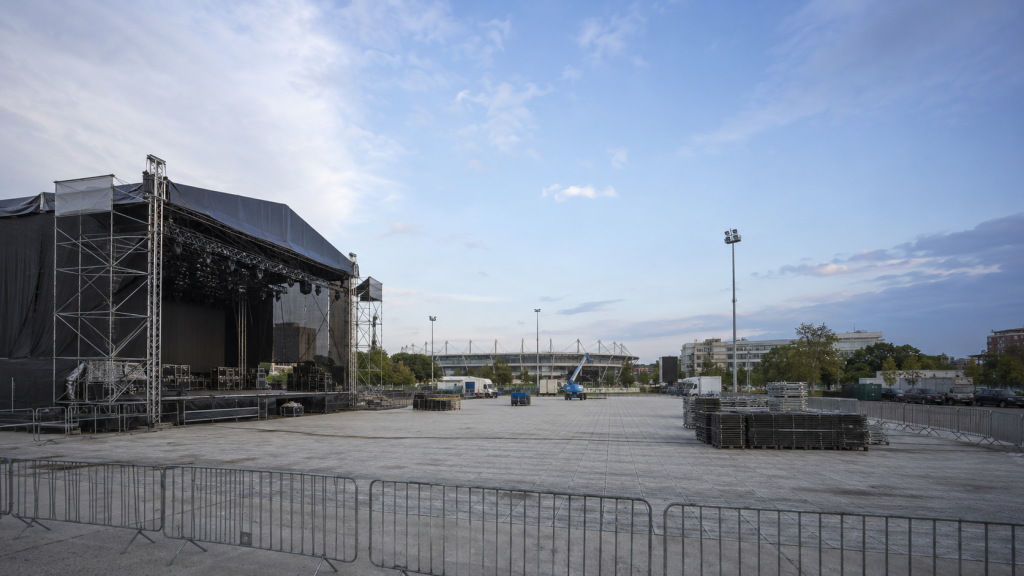
A stadium holding 40,000 people is one of the electromagnetically loudest places that exists. Tens of thousands of handsets, WLAN cells, press uplinks, stage radio, emergency services, stewarding, broadcast — all at once, all legitimate, all indispensable.
Two things follow.
Detection has to hear through that noise. Methods that depend on a clean spectrum deliver either nothing or permanent false alarms here. So we calibrate in the real environment — before the event, with the systems running, not on an empty pitch.
Effect must not damage that environment. A broadband countermeasure over a stadium takes down emergency services radio, cuts the broadcast and hits 40,000 handsets. That isn’t collateral damage. That’s a second emergency. Anything that acts on an airframe has to stay confined to that airframe. This requirement rules out a substantial share of what the market sells.
Scope of work
| Phase | Work |
|---|---|
| Lead-up | Terrain analysis, realistic launch points in the surrounding area, approach sectors, coordination with police and organiser, escalation chain agreed. |
| Baseline | RF environment measured before the event. Capture of the normal state — without a reference, no deviation is visible. |
| Pre-event | Operation in the days before. The target is the reconnaissance, not the event day. |
| Build-up | Temporary sensing installed. Setup in hours, without touching event logistics. |
| Operation | Staffed throughout the event. Connected to the incident command on site, not to a remote centre. |
| Response | Graduated, per the agreed chain. Usually: locate the pilot, hand over to stewarding. Anything further requires an authority mandate. |
| Break-down | Complete, no residue. |
| Debrief | Report covering every incident, analysis, recommendations for follow-on events. Data deleted per the agreed period. |
Occasions
State visits and summits
Highest demands, clearest legal position: usually an authority commands and we contribute. Characteristics: short lead time, high visibility, tight coordination with close protection and aviation security. The protected space is often a route, not a point.
Stadiums and major sport
Recurring, plannable, with established procedures. Advantage: the RF environment is known across a season and the baseline grows. Challenge: the sheer number of legitimate flights — broadcast, survey, press.
Open airs and festivals
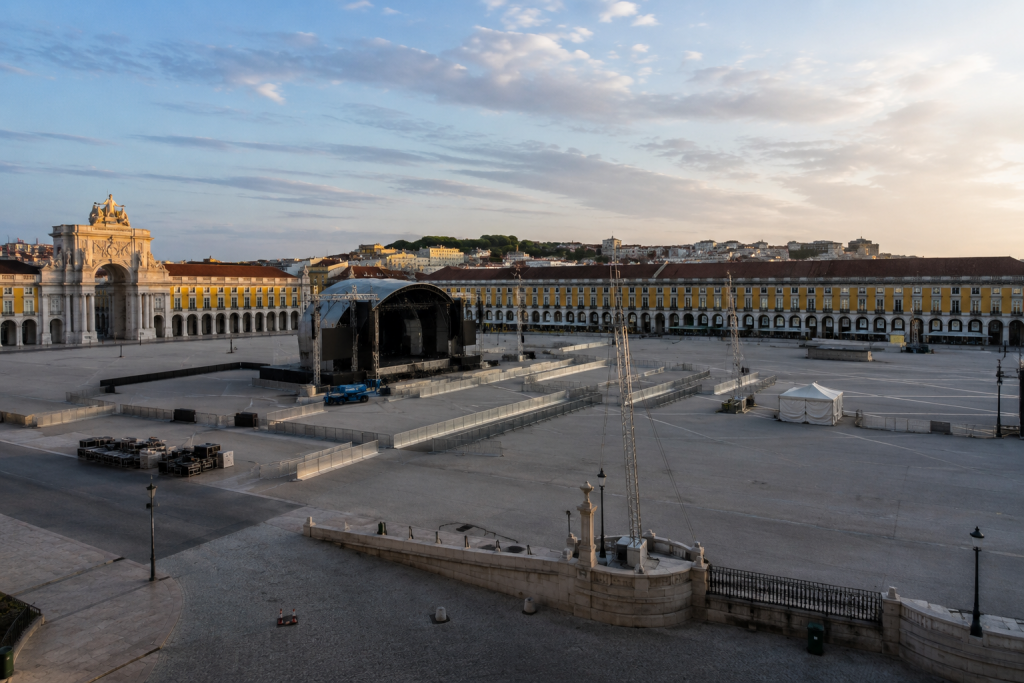
Large sites, several days, open geometry with no built boundary. Launch points sit in the surrounding terrain, often outside the event ring. Detection has to reach further out than at an enclosed stadium.
Trade fairs and congresses
Mostly enclosed buildings, but a different threat: reconnaissance against exhibitors, industrial espionage, access control from above. The airspace over a trade fair is rarely the target — the roof plant and the delivery yards are.
Municipal occasions
Parades, town festivals, new year events. Limited budgets, limited staffing. Here the honest recommendation is often: no hardware. A concept and an exercise. See Advisory.
Working with others
Event protection only works as a joint effort. We’re one part of it, not the solution.
With the organiser we settle geometry, schedule, access and the question of which flights are legitimate. That list is decisive — without it, every detection is an alarm.
With the police we settle the mandate. Who may do what, from when, on what report. Effect measures across the EU sit with the authority, not with a private contractor. We supply the picture the decision rests on.
With stewarding we settle the most common response there is: someone walks over to the pilot. For that, stewarding needs a position, a description and a call — in a form that works over a radio, not on a screen.
With incident command we settle where our picture surfaces. Answer: with them, on site, in the same room. Not in a remote centre reporting by phone.