AIR · Area 2 of 4
Air Superiority
Superiority isn't a question of range. It's knowing what's in the airspace earlier — and answering faster than the other side learns.
The shift
Air defence spent decades doing arithmetic with large numbers: expensive platform against expensive platform, few targets, long warning time. That arithmetic has broken. The other side now flies airframes that cost less per unit than the munition intercepting them — and flies many of them at once.
Which moves the decisive factor. It no longer sits in the range of any single effector. It sits in three other numbers. How early an object is detected. How reliably it is classified. How cheaply it is neutralised. Intercept a €400 drone with a €400,000 missile and you win the engagement while losing the war — the other side can repeat that trade indefinitely.

The kill chain
We treat the airspace as one continuous process, not a collection of boxes. Every link is only as strong as its handover to the next — and the handovers are precisely where most systems break.
Detect
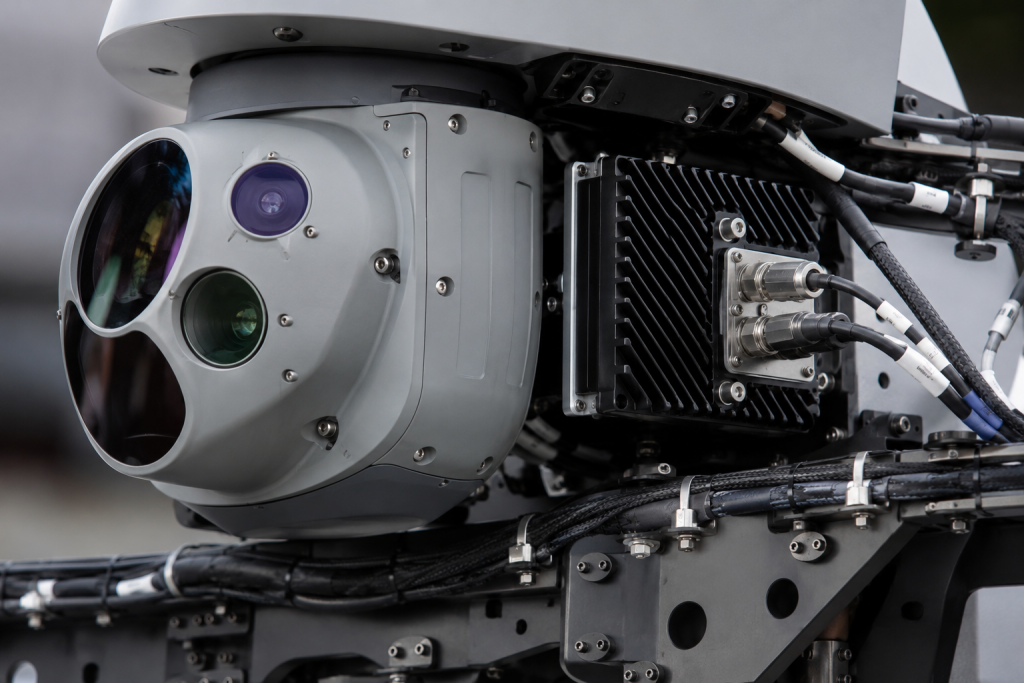
An object doesn’t exist for the defence until a sensor sees it. Small, slow, low-flying airframes get filtered out by classical air surveillance as clutter — they’re too unremarkable for it. So we run several physically distinct principles in parallel: what one method misses, another catches. Here redundancy isn’t a safety margin. It’s the base function.
Classify
A contact is not yet a target. Bird, air ambulance, permitted survey drone, unknown airframe? That call gets made in seconds, and it gets made wrong when the data is thin. Fusing multiple sensor sources delivers the confidence a single source doesn’t have.
Assess
A target is not yet a threat. Flight path, speed, behaviour and proximity to the asset produce a rating — against your rule set, not ours. An airframe flying the perimeter in parallel is a different case from one heading in.
Assign
Which response fits this case, under this mandate, at this location? Assignment is where technology meets law. It has to be defined beforehand, not in the moment of decision.
Engage
Graduated, proportionate, documented. Specified case by case — subject to mandate, environment and national law.
Exploit
Every incident is an input to the next. Signatures, flight patterns and behavioural profiles feed back into classification. A system that goes static after installation loses within a year to an adversary that keeps learning.
The weakest link is almost never the sensor. It’s the handover from „detected“ to „someone decides“. That’s where the time bought at the front end gets spent.
Layering
A single ring around an asset isn’t a defence. It’s an alarm button. Effective layout is layered — each zone carrying its own job and its own time horizon.
| Zone | Task | Time horizon |
|---|---|---|
| Early warning | Detect the approach, establish the sector, prime the alert chain. | Minutes |
| Detection | Build the track, classify, derive launch point. | Tens of seconds |
| Assessment | Rate against rule set, assign the response. | Seconds |
| Effector zone | Engage, where mandate and proportionality allow. | Seconds |
| Exploitation | Evidence, reporting, feedback into classification. | Hours to days |
The geometry of those zones is not a circle. It follows the terrain, the realistic approach sectors, and what is legally permissible in each ring. A site with forest to the west and open water to the east has two entirely different half-circles.
Swarm and mass
The scenario that breaks every point solution: not one airframe, but twenty. Not from one bearing, but four. Not simultaneously, but staggered across twenty minutes to exhaust the response.
Against mass, range doesn’t help. Three other properties do:
- Parallelism. The system has to hold many tracks at once without losing correlation. A system that starts confusing tracks at eight is blind at twenty.
- Cost symmetry. The response must not cost more than the attack. Otherwise exhaustion is only a matter of time, and the other side sets the clock.
- Automated triage. No human runs twenty simultaneous classifications. The machine sorts, the human decides on what’s left — and on every case where an effector is used.
That last point is a commitment, not a feature: a human decides on the use of effectors. We don’t build systems that make that decision themselves.
Why development happens in Ukraine
The cycle on which drone technology changes has compressed from years to weeks. A countermeasure that works reliably in spring can be obsolete by autumn — because the other side changed a frequency, made a control loop autonomous, or swapped a component.
A development process timed to trade show cycles and procurement windows cannot follow that. It ships systems that, on the day of delivery, are effective against the threat of the day before yesterday.
So Orionyx develops and sources together with contracted partners in Ukraine. What’s built there is built in direct contact with an adversary that is itself learning. What survives that contact hasn’t been validated in a simulation. It’s been validated against someone actively adapting.
For our customers in the EU that means shorter paths between an identified gap and an adjusted answer — and a portfolio that comes out of a feedback loop rather than a catalogue.
More on the partnership and the development model
Deployment profiles
Fixed
Permanent layout around a static asset. Full sensor depth, continuous calibration in a known interference environment, deep integration into the existing command layer. Highest detection performance, lowest flexibility.
Deployable
Stands up in hours, runs for days to weeks, breaks down without a trace. For summits, exercises, temporary situations. The trade-off is calibration time — an unknown RF environment has to be surveyed first. See Event Protection.
Mobile
Vehicle-mounted, protecting a moving asset or a convoy. The hardest profile: the reference frame moves, the interference environment changes constantly, and setup time is zero.
Contributing
Feeding an existing higher-echelon air picture. Our role is then sensing and classification, not overall responsibility. Typical for government and military customers with their own command structure.